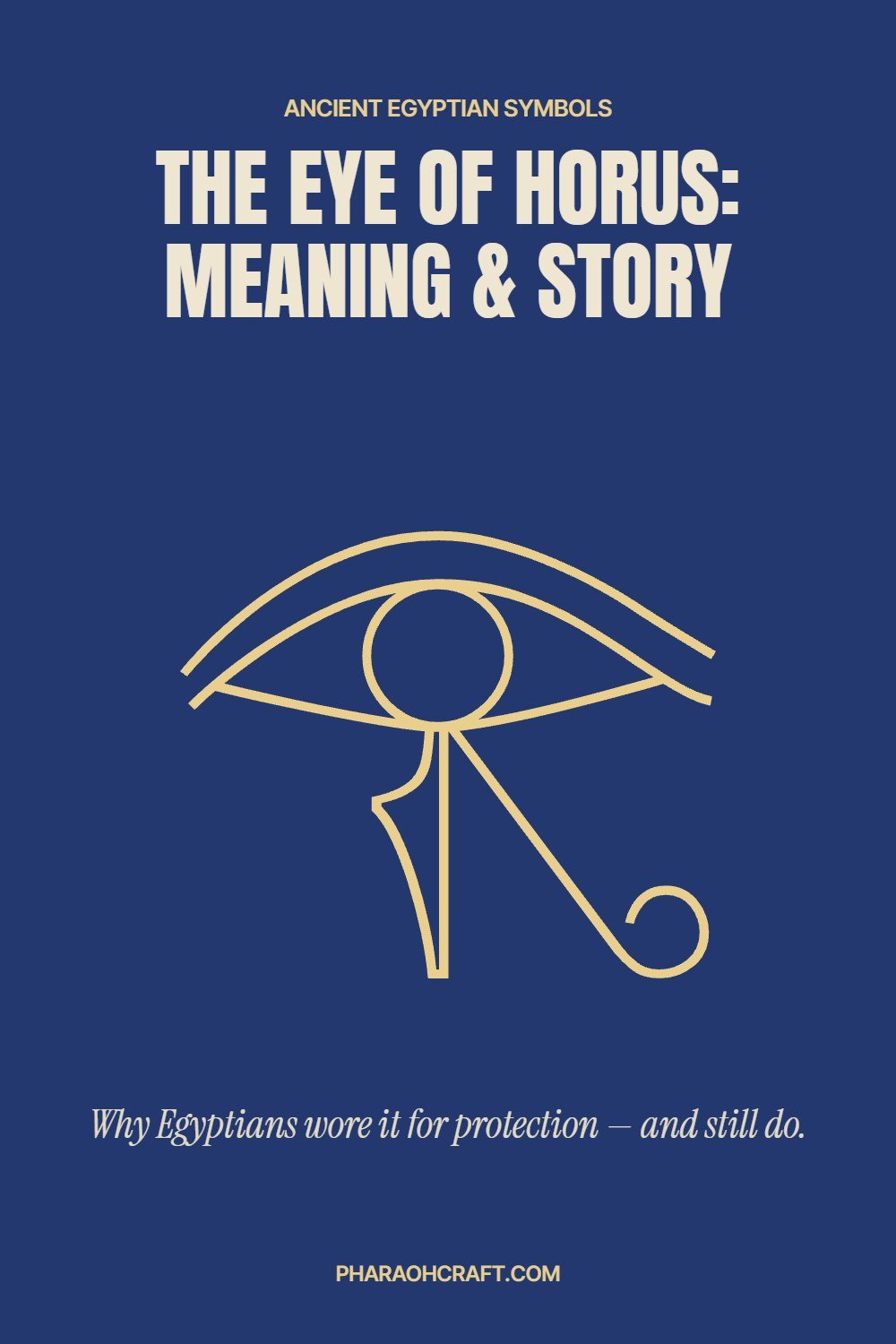
Few symbols have travelled as far as the Eye of Horus. It was painted on coffins, carved into amulets and worn by the living more than four thousand years ago — and today it appears on jewelry, tattoos and streetwear all over the world. Here’s what it actually means.
𓂀
The name: wedjat
Egyptians called the symbol wedjat (also written udjat), usually translated as “the sound one” or “the one that is whole”. That idea of wholeness is the key to everything else about it.
The myth behind the eye
In Egyptian mythology, the falcon god Horus fought his uncle Set for the throne of Egypt after Set murdered Horus’s father, Osiris. During the struggle, Horus’s eye was torn out. It was later restored — in most versions by the god Thoth — and made whole again.
Because the eye was damaged and then healed, it became a symbol of healing, restoration and protection. Horus is even said to have offered his restored eye to Osiris, so the wedjat also came to stand for sacrifice and the gifts that bring life back.
What it was used for
- Amulets for the living — worn for protection and good health.
- Protection for the dead — wedjat amulets were placed in mummy wrappings, and eyes were painted on coffins so the deceased could “see” out.
- Boats and buildings — painted eyes watched over sailors and spaces.
Eye of Horus or Eye of Ra?
The two are often confused. Both belong to sky gods and look similar. A common modern explanation is that the Eye of Horus is linked with the moon and the Eye of Ra with the sun, but ancient texts mix the two ideas freely, and many Egyptologists treat the boundary between them as blurry.
The “fractions” theory
You may read that each part of the eye stood for a fraction — 1/2, 1/4, 1/8 and so on — used to measure grain. The idea is widely repeated, but it’s debated: some scholars see a real connection with old measuring signs, others think the link was made much later. It’s a fascinating theory rather than settled fact.
Wearing it today
People still choose the Eye of Horus for the same reasons Egyptians did: protection, recovery after a hard time, and a feeling of being watched over. If you wear one, you’re joining a tradition thousands of years old.
Original Eye of Horus and falcon art, drawn in Cairo and printed to order.