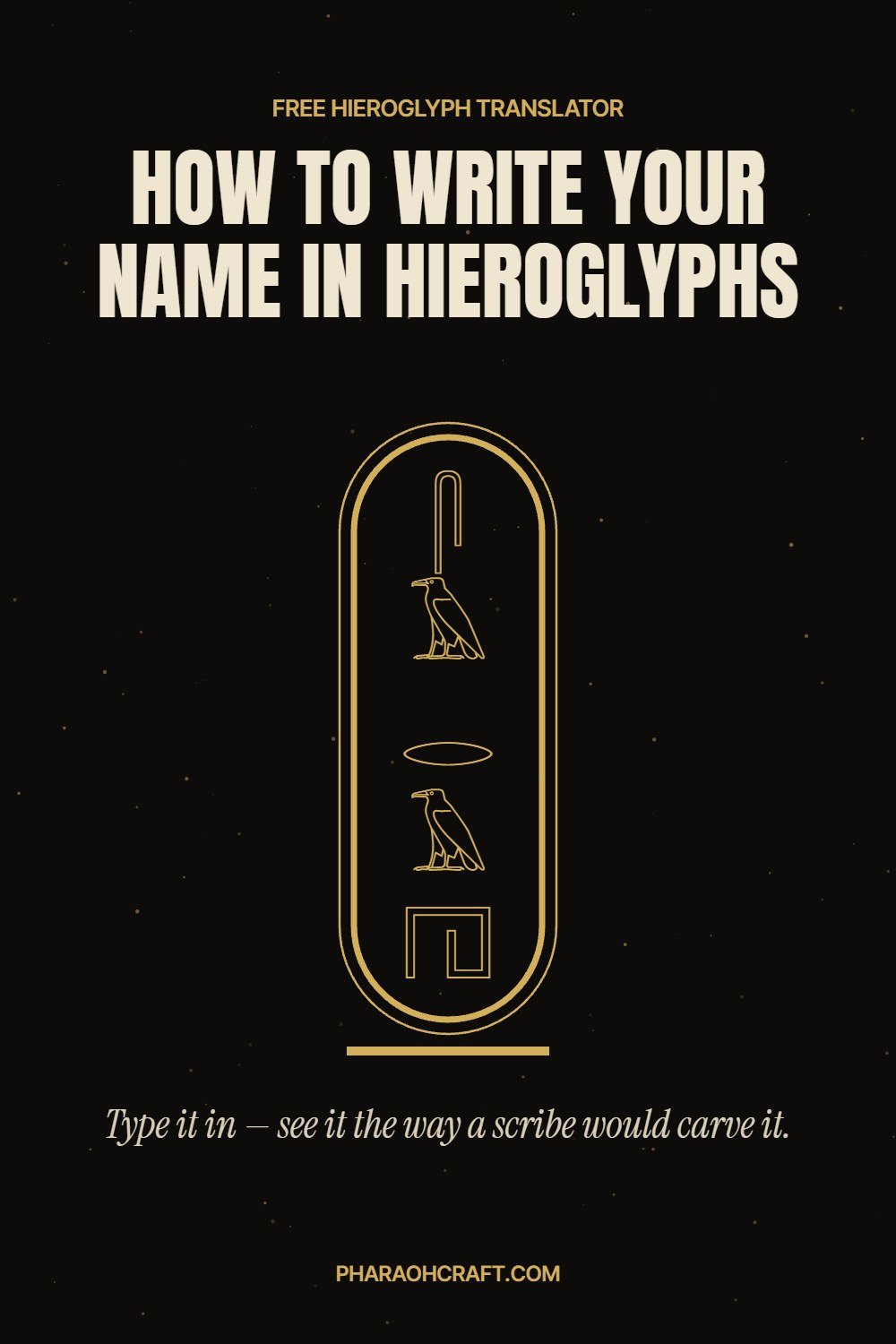
Every pharaoh had a name sealed inside a cartouche — an oval rope ring that was believed to protect the name within it forever. You can see your own name the same way in a few seconds. Type it below.
How the translator works
Ancient Egyptian had hundreds of signs, but a small set of them stood for single sounds — Egyptologists call them uniliteral signs. They work a little like an alphabet, so we can use them to spell modern names by how they sound.
A few honest notes: Egyptians mostly didn’t write vowels, and sounds like V or the English “C” didn’t exist the way we use them today. So every hieroglyph name translator — including this one — is a modern phonetic approximation. It’s the same method museums and Egyptologists use when they show visitors their names in hieroglyphs, and it’s exactly how the names of foreign rulers like Ptolemy and Cleopatra were spelled in ancient times.
The hieroglyph alphabet
These are the signs used above, and what each one actually pictures:
| Letter | Sign | What it shows |
|---|---|---|
| A | 𓄿 | Egyptian vulture |
| B | 𓃀 | Foot |
| C / K | 𓎡 | Basket with handle |
| D | 𓂧 | Hand |
| E / I | 𓇋 | Flowering reed |
| F / V | 𓆑 | Horned viper |
| G | 𓎼 | Jar stand |
| H | 𓉔 | Reed shelter |
| J | 𓆓 | Cobra |
| L | 𓃭 | Lion (lying) |
| M | 𓅓 | Owl |
| N | 𓈖 | Water ripple |
| O | 𓍯 | Coil of rope |
| P | 𓊪 | Stool |
| Q | 𓈎 | Hill slope |
| R | 𓂋 | Mouth |
| S | 𓋴 | Folded cloth |
| T | 𓏏 | Bread loaf |
| U / W | 𓅱 | Quail chick |
| Y | 𓇌 | Two flowering reeds |
| Z | 𓌊 | Door bolt |
Tips for spelling your name
Spell it by sound, not by letters
Write what you hear. “Phillip” sounds like F-L-P, “Kate” like K-T, “Sean” like Sh-N. Silent letters can be dropped, and double letters are usually written once.
Direction is flexible
Hieroglyphs can be written left to right, right to left, or top to bottom. The trick for reading them: people and animals face the start of the line. Royal cartouches were often written vertically — use the Vertical button above to see yours that way.
Why a cartouche?
The oval ring is a stretched version of the shen, a loop of rope with no beginning and no end — a symbol of eternity. Only royal names were written inside it. Cartouches are also how modern scholars cracked the code: in 1822, Jean-François Champollion compared the cartouches of Ptolemy and Cleopatra on the Rosetta Stone and other inscriptions, and used them to decipher hieroglyphs.
Like how your name looks? We’ll carve it in gold on a hoodie — preview approved by you before printing.
Frequently asked questions
Is this the “real” way my name was written in ancient Egypt?
Your name didn’t exist in ancient Egypt, so there’s no single “real” version. This is the standard phonetic way of writing a modern name with genuine Egyptian signs.
Can I use the image I download?
Yes — the download button gives you a free image of your cartouche for your phone wallpaper or social media.